How the 2026 Constitutional Referendum Came About — and Why the People Said No
The Maldives' first nationwide referendum in nearly two decades asked a simple question about election timing. The answer revealed deep public sentiment about power, accountability, and the future of democracy.
Mohamed Zahir
Editor-in-Chief
April 16, 2026
12 min read
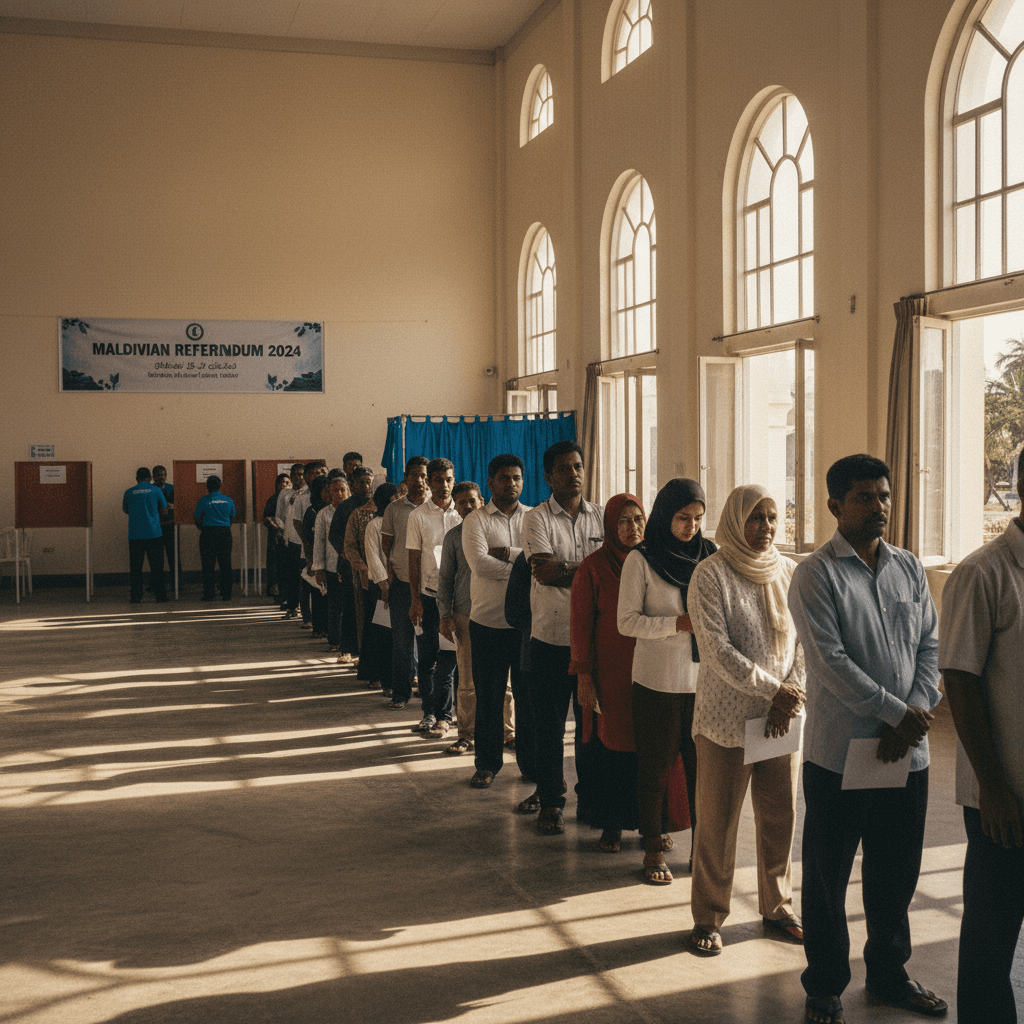
On April 4, 2026, the Maldives held its most complex electoral exercise since the introduction of multi-party democracy in 2008. Voters across all 26 atolls were handed three separate ballots: one for local council representatives, one for Women's Development Committee members, and one bearing a question that would test the very foundations of the nation's democratic architecture.
The constitutional referendum — the first nationwide vote of its kind since 2007 — asked citizens whether they approved the Eighth Amendment to the Constitution, which would synchronise presidential and parliamentary elections and shorten the current parliamentary term by five months. When the ballots were counted, the answer was unequivocal: 68.7 percent voted against.
The Genesis: A Super-Majority's Ambition
The story of the referendum begins in January 2026, when President Mohamed Muizzu's administration and the ruling People's National Congress (PNC) introduced a constitutional amendment bill to the People's Majlis. The PNC, which commands an overwhelming majority in parliament, framed the proposal as a common-sense reform: by aligning the presidential and parliamentary election cycles, the government argued, the Maldives could save significant public funds, reduce the disruption caused by frequent elections, and create a more stable governing environment.
The bill moved through parliament at remarkable speed. On February 10, 2026, during just the second sitting of the year's first parliamentary session, it passed with 72 out of 73 MPs voting in favour. Opposition lawmakers from the Maldivian Democratic Party (MDP) staged protests but were numerically powerless to stop the amendment. Under Maldivian constitutional law, however, amendments affecting the structure of elections and parliamentary terms require approval through a public referendum before receiving presidential ratification.
What the Amendment Proposed
The Eighth Amendment, as it came to be known, contained two core provisions. First, it would end the current parliamentary term on December 1, 2028, approximately five months earlier than the scheduled expiry in May 2029. Second, it would permanently align future parliamentary elections with the presidential cycle, creating a single election day every five years.
The ballot question read: “Do you approve the ratification of the Eighth Amendment to the Constitution, which provides for the Presidential and People's Majlis elections to be held concurrently and for a change to the term of the People's Majlis?”
President Muizzu issued a Presidential Decree scheduling the referendum for April 4, coinciding with the local council elections, a decision the government said would minimise administrative costs.
The Case For: Efficiency and Stability
Supporters of the amendment marshalled several arguments. Parliamentary majority leader Ibrahim Falah publicly backed concurrent elections, while Attorney General Ahmed Usham contended that holding simultaneous elections would “reduce the unrests happening in the country.” Government representatives highlighted practical benefits: fewer school closures for polling stations, consolidated election worker training, and simplified inter-atoll transportation logistics.
The Maldives Development Alliance, the Jumhooree Party — whose leader Qasim Ibrahim called reform “long overdue” — and the Adhaalath Party all endorsed the amendment. Their central argument was that a nation of half a million people could not afford the governance paralysis caused by near-constant election cycles.
“Every two years, governance effectively pauses as politicians focus on winning seats rather than serving the people. Concurrent elections would give us five uninterrupted years to actually build this nation.”
— Ibrahim Falah, Parliamentary Majority Leader
The Case Against: Power, Accountability, and Democratic Safeguards
The opposition's argument was equally forceful and, as the results would prove, far more persuasive. The MDP led the charge, with former chairperson Fayyaz Ismail characterising the amendment as an attempt to secure incumbency advantage “through the backdoor.” Critics warned of the “coattail effect” — the well-documented tendency in political science for voters in simultaneous elections to select the same party across all ballots, thereby concentrating power and weakening the separation between executive and legislative branches.
Three former presidents — Mohamed Nasheed, Ibrahim Mohamed Solih, and Abdulla Yameen — all opposed the amendment, a rare alignment that underscored the depth of concern across the political spectrum. The MDP also filed judicial review petitions challenging the referendum's lawfulness and requesting injunctive relief, though these were ultimately unsuccessful.
Constitutional experts raised additional concerns. Husnu Al Suood, a prominent legal scholar, questioned whether the ballot language met the clarity standards required under Article 262 of the Constitution. Transparency Maldives, the country's leading civil society organisation, flagged six significant shortcomings in the process: one-sided official messaging, risks to ballot secrecy affecting over 6,000 voters, absence of campaign finance rules, insufficient referendum question clarity, and the exclusion of overseas Maldivians from the referendum vote.
The Verdict: A Decisive No
When the votes were tallied on the evening of April 4, the margin was striking. Of 294,876 registered voters, 221,111 cast ballots — a turnout of nearly 75 percent. The results were unambiguous:
The Aftermath: More Than a Constitutional Question
President Muizzu, posting on X shortly after the results were announced, said he “fully accept[ed] election results and congratulate[d] those who won,” pledging to continue addressing governance issues. PNC Vice President Ahmed Shiyam acknowledged the outcome indicated “necessary strategic adjustments.”
But the opposition read the results as something far larger than a vote on election timing. Former President Mohamed Nasheed characterised it as a unified “no” against the government across all three concurrent votes. Former President Ibrahim Mohamed Solih stated the government must “revise its public policies to keep in line with public sentiment.”
Political analysts broadly agreed. The referendum's defeat, combined with opposition gains in the local council elections held on the same day, was widely interpreted as a referendum on the Muizzu administration's broader governance record — a sharp rebuke delivered through the ballot box, using the very democratic mechanisms that the amendment would have restructured.
“The people of the Maldives have reminded their leaders of a fundamental truth: in a democracy, the architecture of accountability is not for the powerful to redesign at their convenience.”
— Analysis, Atoll Islands Editorial Board
The 2026 referendum will be remembered as a defining moment in the Maldives' young democratic history. It proved that even when a ruling party commands a near-total parliamentary majority, the people retain the ultimate veto. The constitution held. The checks and balances survived. And the Maldives, for all its challenges, demonstrated that its democracy is more resilient than many had feared.
Mohamed Zahir
Editor-in-Chief
Mohamed Zahir has led the Atoll Islands editorial team since its founding. A veteran of Maldivian journalism with 20 years of experience, he previously served as a BBC World Service correspondent.